 Drying Technology

Working mechanism:
The 5HLR heat pump tower dryer consists of multiple sets of vertically
arranged drying sections and a dehumidifying heat pump. The drying
sections and the dehumidifying heat pump form a closed drying
system. The material passes through each drying section from top to
bottom, where it undergoes cyclic drying by the dehumidifying heat
pump. The entire drying process achieves over 95% energy recycling.
What we applicated in:
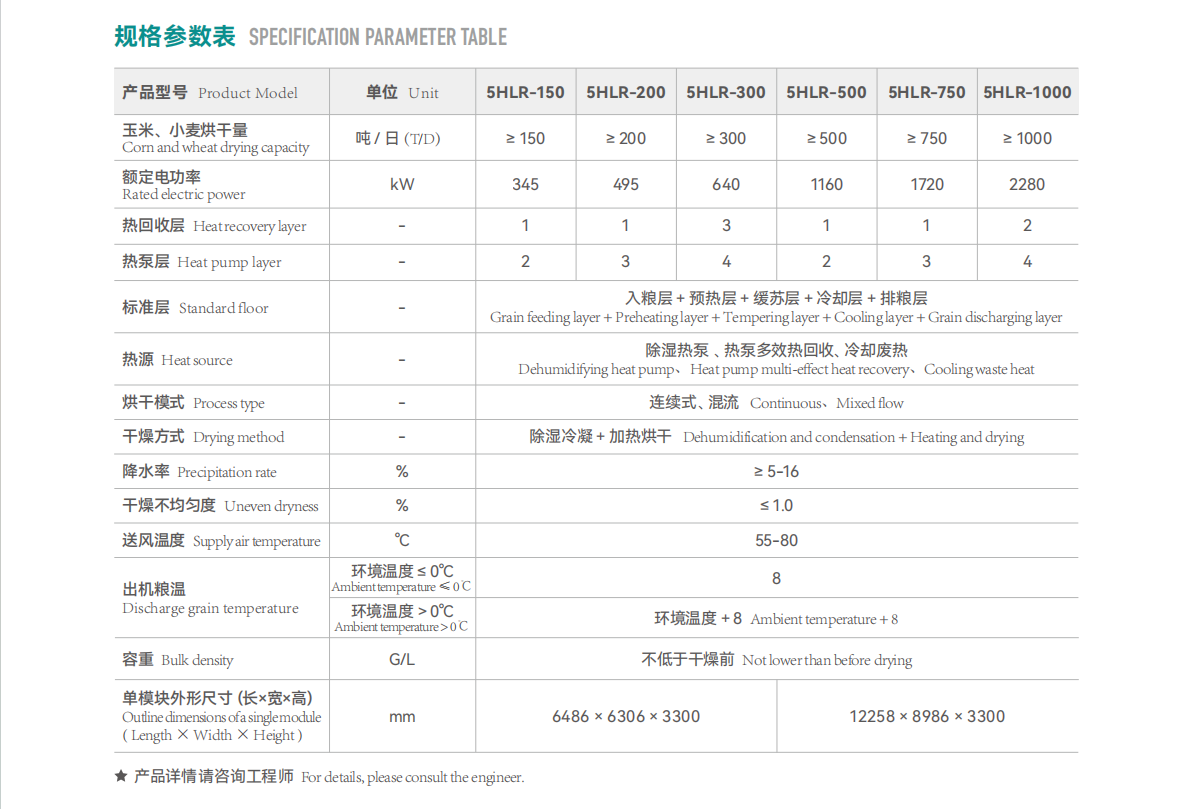
Drying treatment of grain and oil crops such as rice,
wheat, corn, sorghum, rapeseed, and various types of grains.
A dehumidifying heat pump is a combination of dehumidification (drying) and heat pump (energy recovery). It utilizes a refrigeration system to cool and dehumidify hot and humid air. It is a device that recovers the latent heat of condensation from air moisture through the heat pump principle, and then heats the air. The heat source is the condensation heat released during the phase change of water vapor in the air, which achieves energy recycling during a closed low-temperature (40-60℃) drying process.
Air flow process: The hot air from the drying room heats up the material, causing it to absorb heat and vaporize its moisture. The air absorbs moisture, turning into hot and humid air. This air then enters the evaporator, where it cools down to a temperature below the dew point, causing water vapor to condense and release latent heat of condensation. The air then enters the air condenser, where it absorbs heat released during the refrigerant condensation process, heating the air. The air then flows through the main fan and back to the drying room.
Refrigerant process: The low-pressure liquid refrigerant absorbs heat from the air in the evaporator, vaporizes into a low-pressure superheated gas, and then enters the compressor. The low-pressure superheated refrigerant gas undergoes isentropic compression in the compressor, transforming into a high-grade, high-temperature, and high-pressure gas. It then enters the air-cooled condenser, where it releases condensation latent heat to become a high-pressure liquid. After passing through the expansion valve and being decompressed into a low-temperature, low-pressure liquid, it returns to the evaporator.
Significant environmental protection effect
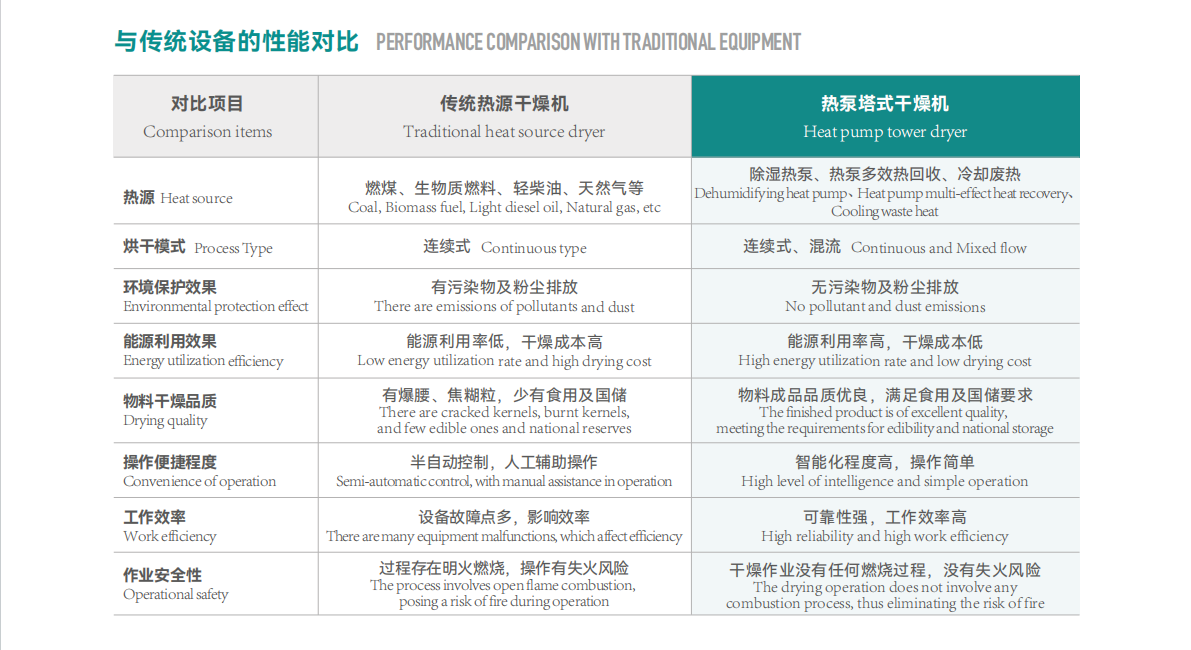
Utilizing the dehumidification heat pump drying principle to achieve high-quality drying of grain and economical and efficient utilization of thermal energy, the system eliminates emissions of CO2, SO2, NO2, and slag due to the absence of any oxidative combustion processes. It achieves energy conservation and consumption reduction, with significant environmental protection effects.
Utilizing closed hot air circulation and recovery technology, a reliable dust removal system is employed to collect impurities, floating debris, and dust generated during the drying process, effectively achieving near-zero pollution to the surrounding environment. The system achieves a recovery rate of over 95% for bran dust.
Long service life and strong work reliability
The service life of the heat pump continuous grain drying system is 8-12 years, which is approximately 100% longer than the 5-6 years of traditional heat source drying towers.
The process technology is mature, with stable performance, safety, and reliability. The heat pump system of the continuous grain drying device consists of multiple-stage heat pump units, each of which employs multiple vapor compression heat pump systems operating simultaneously, resulting in low maintenance downtime and failure rates.
High quality material drying
Adopt medium and low temperature drying methods for grain and economic crops, featuring calibration, constant temperature, and hot air drying (with a minimum return air temperature of 40°C).
The dried grains are free from cracked kernels and burnt grains, clean and tidy, with stable physicochemical indicators and excellent quality, meeting the requirements of breeding, pharmaceuticals, food processing, high-quality commercial grains, and national commercial storage. The test weight of the dried grains is 2%-3% higher than that of traditional heat source drying towers.
High degree of automation
Utilizing automatic temperature control, it conducts 24-hour continuous drying operations with high levels of automation and intelligence. The operation is simple, reducing labor costs and labor intensity for workers.
High Efficiency and Energy Saving
The heat pump has a heating COP of over 4. Compared with traditional heat source drying devices, heat pump drying devices have higher energy efficiency, and the drying cost is reduced by over 40%.